
Gojoseon: The Foundation of Korean Civilization and Its Legendary Origins
At what point does the story of a nation start? In the case of Korea, it is Gojoseon, the ancient kingdom which has formed the basis of South Korean way of life more than 4,000 years ago. The merging of mythology with the evidence of archeology makes this impressive kingdom an engaging origin story that continues to define Korean identity even today. Knowing Gojoseon provides a traveler and culture lovers with a very necessary context of enjoying the rich historical origins of modern Korea.
Gojoseon is not merely about ancient history. It brings the Korean consciousness, language and cultural values to birth. Another icon of Korean nationalism is the legendary founder of the kingdom, Dangun. Koreans celebrate the establishment of Gojoseon every October 3rd, which is termed National Foundation Day. This historical legacy still contributes to the way the Koreans understand themselves and their role in world history.
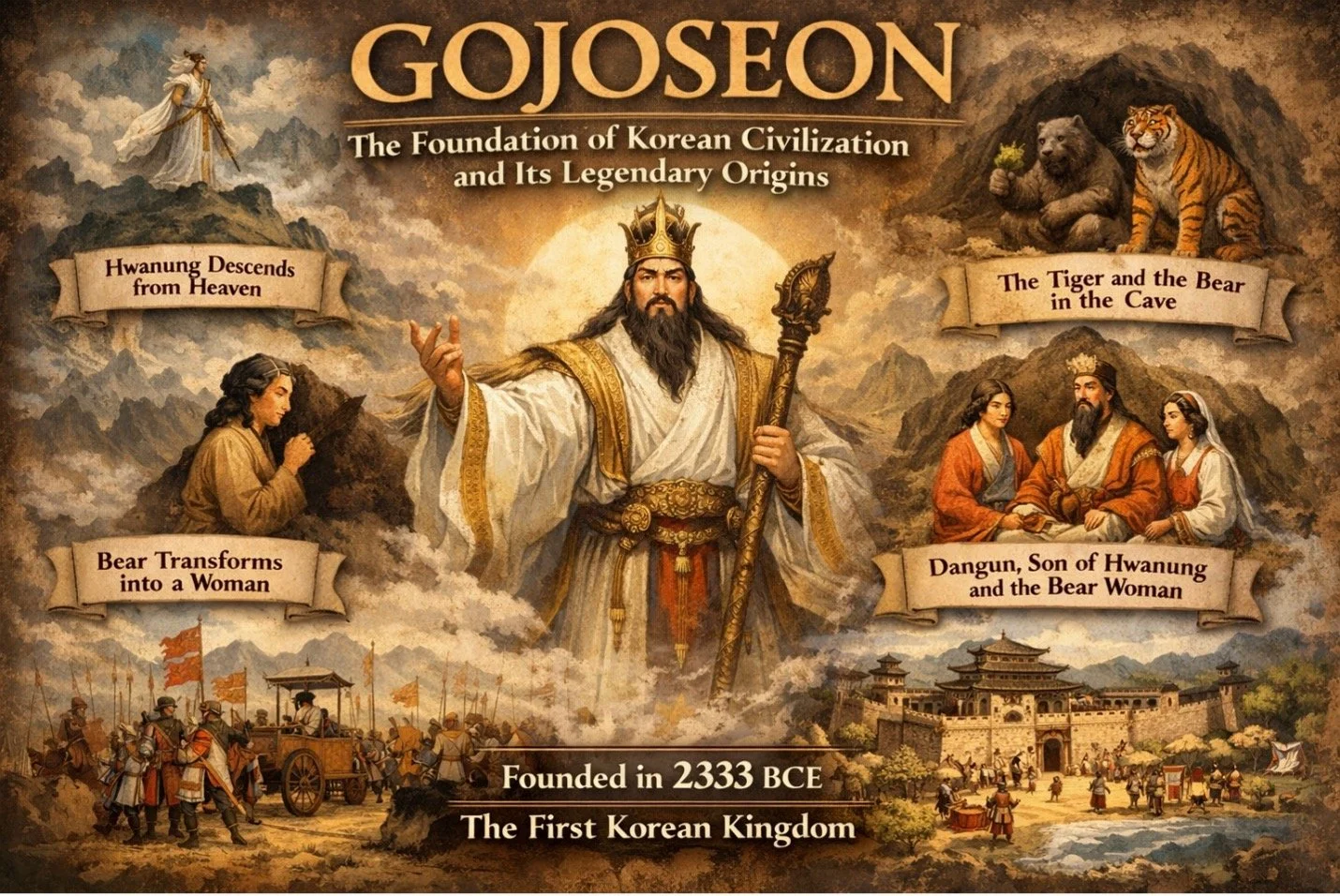
The Legend of Dangun: Korea's Founding Myth
All great civilizations have a story of their creation. The myth of the origin of Gojoseon's is based upon the story of the birth of Dangun Wanggeom through a mixture of divine and mortal forces. It is a story that not only describes the origins of Korea but also essential Korean values which linger on today.
The Heavenly Prince and the Sacred Cave
The legend starts with Hwanung, who is the son of Lord of Heaven. He went down to Mount Baekdu, with 3,000 followers, in hopes of making an earthly kingdom. Hwanung carried with him God’s blessings such as laws, moral teachings and farming teachings. The Sacred Sandalwood Tree gave him control over wind, rain, and clouds.
A tiger and a bear went to Hwanung and asked him to transform them into humans. He provided them with twenty cloves of garlic and a bundle of mugwort. They were required to stay in a cave during 100 days and consume only these. The tiger gave up the task in twenty days. However, the bear persevered. She changed herself into a female called Ungnyeo.
The Birth of Dangun and Gojoseon
Ungnyeo prayed to have a child beneath the Sacred Sandalwood Tree. Hwanung was moved by her devotion and he assumed a human form and wedded her. In 1000 BCE, they had a son called Dangun Wanggeom. According to legend, he set up the first kingdom in Korea called Gojoseon which governed 1,500 years.
This myth has great symbolism. The bear symbolizes endurance and patience which are highly regarded in the Korean culture. The marriage of heaven and earth is associated with the fact that Korea is between the divine and mortal realms. In addition, the focus on making it through tough times is echoed throughout Korean history.
Historical Evidence and Archaeological Discoveries
Leaving the mythology behind, archeological data proves that Gojoseon was an actual political body. The modern knowledge bases its understanding on the combination of ancient literature and material objects to recreate the history of this ancient kingdom.
Territory and Timeline
Gojoseon had dominated the northern Korean Peninsula and the southern Manchuria. This ancient kingdom is referred to in Chinese historical scripts and especially in the “Records of the Grand Historian”. One can find bronze artifacts, pottery, and tools of agriculture available as archaeological sites. Physical evidence of the Bronze Age culture of Gojoseon can be found in Dolmen burial sites throughout Korea.
The kingdom must have developed in the period 1000 BCE yet it is traditionally dated earlier. It developed into a centralized state out of dispersed tribal bands. By 4th century BCE, Gojoseon had evolved advanced political structures. The kingdom had complicated ties with other Chinese kingdoms.
The Eight Laws of Gojoseon
Ancient texts preserve fragments of Gojoseon's legal code. Three laws survive in historical records. They prohibited murder, injury, and theft. Punishments were severe, reflecting the importance of social order. Murderers faced execution. Those who injured others had to compensate with grain. Thieves became slaves to the families they wronged.
These laws reveal Gojoseon's social values. Life, physical safety, and property rights received legal protection. The harsh punishments suggest a society valuing stability and hierarchy. Therefore, these ancient laws show early Korean emphasis on social harmony and collective responsibility.
The Wiman Joseon Period and Fall
The later period in Gojoseon witnessed a lot of changes in politics. In the year 194 BCE, a Chinese refugee by the name Wiman assumed power. He founded the Wiman Joseon dynasty which lasted until the collapse of the kingdom.
Transformation Under Wiman
Wiman Joseon was the strongest period of Gojoseon. The kingdom dominated key trade routes between the Chinese and the Korean Peninsula. The development of iron technology was quite intense in these years. There was greater centralization of politics and this resulted in a more advanced state apparatus.
This prosperity however came with its own share of unwanted attention. The Han Dynasty considered Wiman Joseon as a threat to their interests. During the 2nd century BCE, diplomatic tensions increased. Lastly, Han Emperor Wu waged war against the kingdom.
The Han Conquest
Han forces overcame Gojoseon after a long period of war in the year 108 BCE. The Han Dynasty split up the territory into four commanderies. This signaled the termination of the first kingdom of Korea. However, the legacy of Gojoseoncontinued to exist in later forms of Korea.
The fall changed the political landscape of the Korean Peninsula. Original Korean tribes still opposed the Chinese domination. This led to new kingdoms which emerged as a result of these resistance movements. This led to the collapse of Gojoseon, thus bringing about the Three Kingdoms period, which further advanced the Korean civilization.
Gojoseon's Cultural Legacy
The ancient Gojoseon provided the basis of the entire Korean history. The cultural, linguistic and spiritual heritage of the kingdom lasted thousands of years.
Language and Writing
Early development of Korean language took place during Gojoseon period. No written documents about this period exist in Korean, but there is linguistic evidence of language continuation. The initial step leading to the present Hangeul was the linguistic heritage of Gojoseon.
Religious Traditions
Shamanism thrived in Gojoseon, with spiritual practices still existing to date. The cult of heaven, the worship of nature, and the rites of the ancestors appeared during this time. These teachings were blended with subsequent Buddhism and Confucianism to form the spiritual and religious environment of Korea.
Experiencing Gojoseon Heritage Today
The heritage of Gojoseon is available to modern travelers all around Korea. A number of places are left as reminders of this ancient kingdom.
UNESCO World Heritage Dolmen Sites
Korea has the highest density of dolmen tombs in the world. Gochang, Hwasun and Ganghwa dolmen became a part of UNESCO World Heritage. These huge monumental buildings are dated to Gojoseon era. Visitors are given an opportunity to observe the burial practices of the Bronze Age.
Museums and Cultural Centers
Gojoseon artifacts are exhibited in the National Museum of Korea in Seoul. Life in ancient Korea is depicted in bronze daggers, pottery and tools. There are interactive exhibitions that describe the Dangun myth and archeological sites. These sites are important pieces of testimony about East Asian megalithic culture according to the documentation of the World Heritage presented by UNESCO.
Modern Significance and National Identity
Gojoseon is an essential part of the Korean national consciousness. Originally, everyone celebrates October 3rd (National Foundation Day Gaecheonjeol) in recognition of the name that Dangun gave to the Kingdom. The founding myth is taught in schools as a national heritage. Dangun is the representative of the Korean independence and cultural uniqueness.
There are still academic arguments on the dates and size of Gojoseon territory. Nevertheless, its role in the Korean identity has never been questioned. The kingdom symbolizes the long and uninterrupted civilization of Korea. Additionally, it creates the Korean culture as a clear separation of the Chinese influence, but it is needless to say that the two are bound together historically.
Conclusion
Gojoseon is the monument of the Korean civilization that unites the myths with the truth of the archaeology. Since there was a miraculous birth of Dangun, till the collapse of the kingdom, this old state set some patterns according to which Korea is shaped nowadays. The value of perseverance, social unity, and nationalism are all instances of the influence of Gojoseon.
Knowledge of Gojoseon changes the way we perceive modern Korea. This is not a mere ancient history, but a living history that forms the modern-day Korean state. To tourists who visit Korea, knowing these traces of ancient heritage enriches all the cultural experiences. Gojoseon is a reminder that the great step of Korea to the present is not measured in decades and centuries, but millennia, that produces one of the most stable civilizations ever in the world.
Frequently Asked Questions (FAQs)
Is Gojoseon real or just a myth?
As recorded in archaeological records and the Chinese history, Gojoseon was the actual kingdom, but there are some rare elements of the myth about the birth of Dangun in the Dangun founding myth, however the period of the kingdom is around 1000 BCE to 108 BCE.
When did Gojoseon actually exist?
According to traditional Korean dating, Gojoseon was founded in 2333 BCE, although most historians have placed it around 1000 BCE and collapsed to the Han Dynasty in 108 BCE and lasted about 900 years.
What does Dangun mean to modern Koreans?
Dangun is a symbol of the identity and independence of the Korean people; he is the exemplar of the early Korean history that does not conform to the Chinese civilization and his tradition is observed on National Foundation Day (3rd October annually).
Where can I see Gojoseon artifacts in Korea?
Artifacts of the Bronze Age, including those of Gojoseon, are found in the National Museum of Korea in Seoul and bronze age dolmen sites in Gochang, Hwasun and Ganghwa provide bronze age burial sites.
How does Gojoseon relate to the Three Kingdoms?
The fall of Gojoseon in 108 BCE resulted in power vacuum which later gave rise to the period of three kingdoms (57 BCE -668 CE); the kingdoms of Goguryeo, Baekje and Silla regarded themselves as the heirs of Gojoseon.