
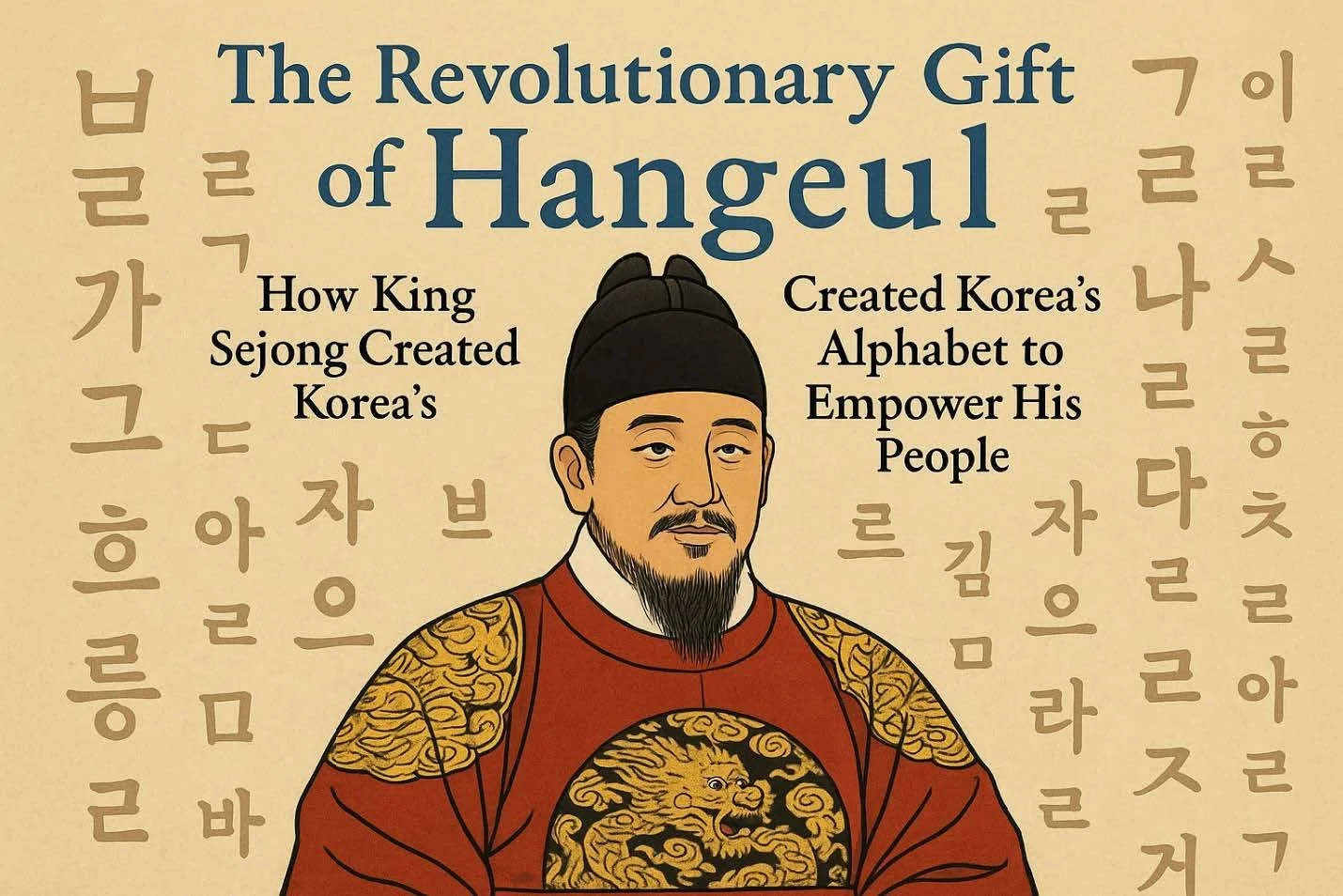
The Revolutionary Gift of Hangeul: How King Sejong Created Korea's Alphabet to Empower His People
Have you ever asked yourself why the Korean is so different compared to Chinese or Japanese writing? The solution is one of the most extraordinary history tales of innovation and passion. The Korean unique alphabet Hangeul is a symbol of revolutionary vision of one king. Hangeul, as opposed to most writing systems that developed over centuries, was purposely developed by King Sejong the Great in the 15th century. He had a simple but a powerful mission to provide every Korean the opportunity to read and write.
It was not a mere creation of letters and sounds. It was also a social revolution that undermined the monopoly of knowledge of the elite. The Hangeul is today being remembered as one of the most scientific and efficient writing systems in the world.
The Historical Context: Korea Before Hangeul
A Nation Divided by Literacy
Prior to 1443, there was a major issue in Korea. The rich and the educated were the only ones who could read and write. All written communication was carried out with Classical Chinese characters, called Hanja. These characters were very complicated and required years to master.
The Literacy Gap and Its Impact
Written knowledge was not available to ordinary farmers, merchants and craftspeople. They were unable to read government notices, to write letters, or write their own stories. This caused an enormous disparity between classes. Majority of the population were kept in the dark.
In addition, the Chinese characters did not fit well in the Korean language. Chinese was not similar to Korean grammar and pronunciation. Instead of learning their own language, people were forced to learn a new and absolutely foreign system of writing. This further complicated literacy acquisition.
King Sejong the Great: A Visionary Leader
Early Life and Ascension to the Throne
King Sejong became king in 1418 when he was only 21. Nevertheless, he was still young and this did not deter him as he went on to be one of the greatest rulers of Korea. He had a strong faith in education and innovation.
Recognizing the People's Struggle
The young king observed how his subjects were languishing in illiteracy. He observed how the common citizens faced difficulties in comprehending legal documents. He witnessed the fact hat they were not able to protect themselves in the court since they were unable to read or write. This troubled him greatly.
Thus, a brave choice was made by King Sejong. He would develop a new writing system that is specifically targeted at the Korean language. The other writing systems in the world were first investigated by his scholars at the Hall of Worthies. They learned the Chinese, Mongolian, and other Asian characters to learn how the various languages depicted the sounds.
The Scientific Creation of Hangeul
The Development Process Begins
Its development started in 1443. King Sejong and his team were exceptionally scientific in this undertaking. They did not just steal off existing systems. They instead developed something completely new on the basis of linguistic principles.
Revolutionary Design Based on Phonetics
Hangeul was a revolutionary design. The shape of each letter represented the physical way of sound production. For instance, the letter ㄱ (g/k) mimics the tongue touching the soft palate. The letter ㄴ (n) shows the tongue touching the roof of the mouth. This graphical display made it easy to learn and remember.
The Structure and Official Publication
There were 28 letters originally in the system (24 of them are in use today). These were combined to form syllabic blocks which were easy to write and read. Moreover, the alphabet was able to depict all the sounds that the Korean language has to offer correctly. It was something Chinese characters could not do.
King Sejong published the new alphabet in 1446 in a document called "Hunminjeongeum," which means "The Proper Sounds for the Instruction of the People." His motivation was described in the introduction clearly: ordinary people had thoughts and feelings but no means to disclose them in writing.
Features That Made Hangeul Revolutionary
Hangeul possessed several groundbreaking features:
• Systematic organization: Consonants and vowels followed clear, logical patterns
• Easy to learn: Most people could master the basics in just a few hours
• Phonetic accuracy: Every sound had a corresponding symbol
• Scientific design: Based on phonetics and the physical mechanics of speech
The system of writing was also democratic. It did not entail any special equipment or costly materials. It could be learnt by anyone irrespective of their status in society and riches.
The Opposition: When Progress Faced Resistance
Aristocratic Backlash
This innovation was not welcomed by all. The nobles were violently against Hangeul. They perceived it as a challenge to the elite status in the society. In case everybody was able to read and write, why were they special?
Confucian Scholars' Resistance
The change was especially opposed by Confucian scholars. They believed that giving up Chinese characters was giving up the centuries of their culture. Hangeul was also referred to as "vulgar script" or "women's writing" in order to lessen its significance. They still only used Chinese characters in official and academic circles.
Thus, Hangeul have been the subject of marginalization over centuries. The government documents and literature continued to use the Chinese characters in the ruling classes. The new alphabet was in use by common people, but it was not prestigious and officially recognized.
The Long Journey to Acceptance
Early Adoption by Common People
Hangeul managed to grow even with opposition. Lower classes and women adopted it immediately. They finally possessed a means of writing their minds down. These groups began flourishing in Korean literature.
The 20th Century Turning Point
The 20th century was really the turning point. Struggle of independence in motherland Korea in early 1900s celebrated Hangeul as national identity figure. Activists and scholars made it specifically Korean, independent of either Chinese or Japanese influence.
Hangeul became the official writing system following the World War II and after Korea had attained independence. Its use in education, government, and media became standardized by the government. In the modern world, Chinese characters are no longer prominent in the everyday writing of Koreans.
Hangeul Today: A Source of National Pride
National Celebrations and Recognition
Hangeul is very much pride of the modern Korea. One of the national holidays on October 9th is the Hangeul Day, which celebrates the gift of King Sejong. People learn about this remarkable invention in museums, exhibitions and educational programs.
Global Linguistic Recognition
Hangeul is one of the most scientific alphabets that are known by linguists across the world. Hunminjeongeum was added by UNESCO into from its Memory of the World Register in 1997. The organization went further to institute the King Sejong Literacy Prize to remember the legacy of the alphabet.
Hangeul provides language learners with an easy way into the Korean language. Hangeul can be learned after a day as compared to Japanese or Chinese writing systems which take years to learn. This availability has contributed to the proliferation of the Korean culture throughout the world via K-pop, K-dramas and Korean foods.
Why Hangeul Matters for Modern Visitors
Practical Benefits for Travelers
In case you have set plans about visiting Korea, you can use the Hangeul to upgrade your stay in this country dramatically. You can read road signs, menus of restaurants, and stations in the subway. Even the mere knowledge of the fundamentals can make you feel your way in a confident manner.
Cultural Connection and Local Appreciation
The logical system of the alphabet makes it ideal to learn. Most tourists take time to memorize the letters a few hours before their journey. This is an investment that yields immeasurable returns when you reach Seoul, Busan or any other Korean city.
Moreover, Koreans will gladly know the effort of foreigners who want to learn their system of writing. It recognizes their culture and history. Even the mere efforts to read Hangeul can end up giving pleasant smiles and general help by locals.
Conclusion
The Hangeul story makes us recall that compassion is one of the causes of innovation. King Sejong did not establish this alphabet as a source of glory and conquest. He established it since he felt that every human being needed the ability of reading and writing. His gift of revolution changed the Korean society and culture permanently.
Nowadays, Hangeul is a representation of Korean identity and resourcefulness. It is the symbol of a king who was more devoted to his people instead of preserving the norms. Modern visitors and those who learn the Korean language find appreciation to this amazing writing system given this history. The records of UNESCO indicate that Hangeul is among the greatest success stories of human beings in their democratizing the knowledge.
Whether you want to learn about the culture of Korea, whether you want to visit or have a trip, whether you want to learn its language, Hangeul is your key into the past, present and future of Korea.
Frequently Asked Questions (FAQs)
How long does it take to learn Hangeul?
Hangeul is easy to learn as it can be mastered by the majority of individuals in 2-4 hours. It is incredibly easy to memorize because of the systematic design. Nonetheless, it needs more practice to read fluently as you have to identify the blocks of syllables ahead in a short period of time.
Is Hangeul still the only writing system used in Korea?
Yes, nowadays Hangeul is the major system of writing in South Korea and North Korea. The use of Hangeul is common and some Chinese characters (Hanja) quite infrequently appear in formal documents, newspapers or in academic materials.
Why is King Sejong called "the Great"?
King Sejong earned this title by having done so many other things other than inventing Hangeul. He enhanced technology, science, agriculture and music. But his greatest achievement was invented the Korean alphabet.
Can I visit places related to Hangeul's history in Korea?
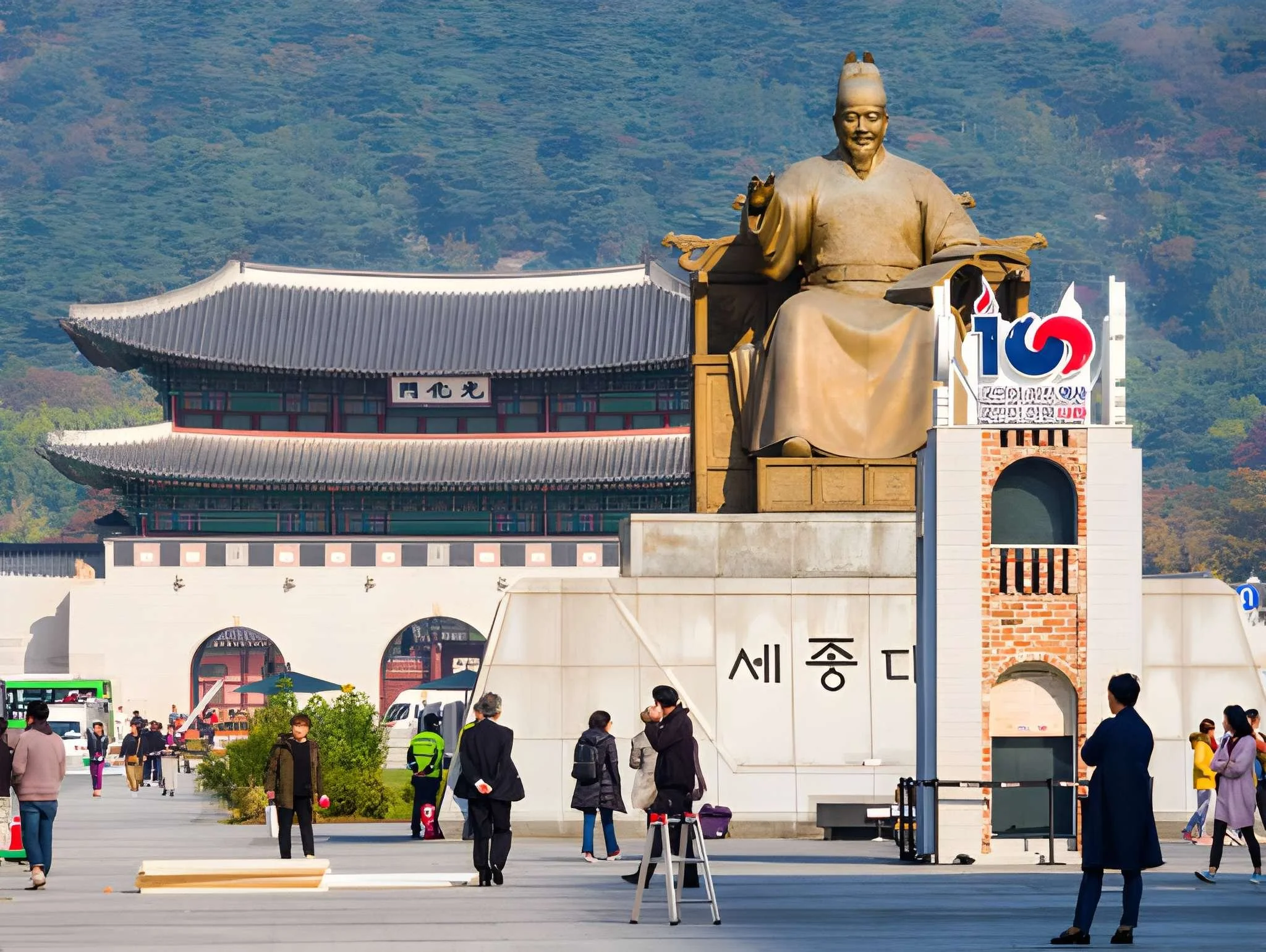
Absolutely! The National Hangeul Museum in Seoul has a large number of exhibits dedicated to the creation and history of the alphabet. Statues of King Sejong are also available in Gwanghwamun Square in Seoul and other places around Korea.
How is Hangeul Day celebrated in Korea?
Hangeul Day (October 9th) is a cultural event that includes various events, exhibition and educational programs. Since special lessons about the history of King Sejong and the history of the alphabet are conducted in schools. Most Koreans contemplate the gift of literacy and the language heritage that Hangeul has become.